
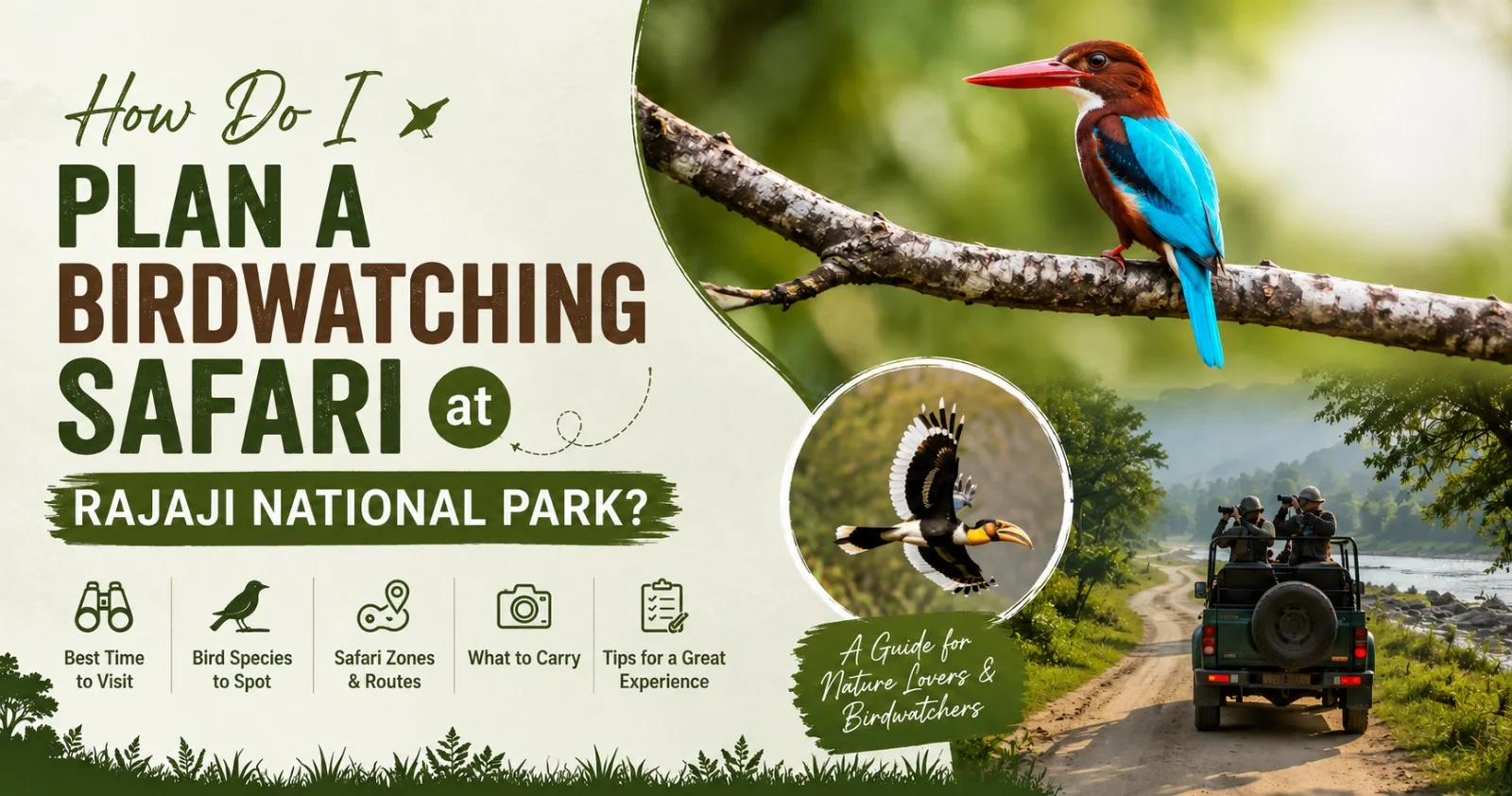
Rajaji doesn’t get the crowds Corbett does, and that’s exactly why serious birders keep coming back — fewer jeeps, quieter mornings, and a checklist that runs past 300 species across sal forest, riverbeds, and Shivalik ridgelines. If you’re trying to actually plan birding at Rajaji National Park — which zone to book, when to go, what it costs — this covers it end to end.
The strongest window for birding is November through February, when winter migrants join the resident hornbills, woodpeckers, and raptors. Book a morning safari (roughly 6:00–9:30 AM) through the official forest department portal or a registered Jungle Safari Rajaji National Park operator, pick a zone based on your priority — Mohand for quiet forest birding, Jhilmil Jheel for waterfowl — and bring your own binoculars, since jeeps only stop at designated viewing points.
Table of Contents
ToggleWhy Rajaji Works So Well for Birding
The park sits right where the Shivalik hills flatten into the Gangetic plain, and that overlap of ecosystems is why the bird list runs so long. You get sal forest species, riverine birds along the Ganga and Song rivers, wetland specialists at Jhilmil, and altitudinal migrants dropping down from the Himalayas each winter. Rajaji holds 11 species of woodpeckers, 5 barbets, and 3 hornbill species — including the Great Hornbill, a genuinely special sighting anywhere in India. The park was formed by merging three older sanctuaries in 1983 and became a full Tiger Reserve in 2015, and that long, undisturbed history is a big part of why the diversity holds up.
When to Go
The park runs on a fixed seasonal calendar. It opens November 15 and closes June 15, when monsoon rains make the forest roads unsafe to drive. Jhilmil Jheel gets a short extension to June 30 since it’s a wetland zone, and Gohri Range is the one exception that stays open through the monsoon entirely. For birders, December and January are hard to beat — migratory ducks, waders, and flycatchers arrive in numbers, and cooler mornings keep birds active well past sunrise instead of retreating into shade by 8 AM the way they do in warmer months.
|
Season |
What’s Present |
Best Zones |
|
Nov–Dec (early winter) |
Migrants arriving, residents active, pleasant weather |
Chilla, Motichur, Mohand |
|
Dec–Jan (peak winter) |
Maximum migratory waterfowl, best raptor visibility |
Jhilmil Jheel, Chilla |
|
Feb–Mar (late winter) |
Migrants still present, breeding activity starting |
Mohand, Motichur |
|
Apr–Jun (summer) |
Residents only, hot but good waterhole activity |
Chilla (early morning only) |
Picking a Zone
Rajaji isn’t a single continuous safari area — it’s split into separate gates, each needing its own permit and each with a distinct character:
|
Zone |
Distance & Base |
Known For |
Good For |
|
Chilla |
~10 km from Haridwar |
Elephants, tigers, river landscapes |
First-time visitors, easiest access |
|
Motichur |
~8 km from Haridwar |
Dense sal forest, leopards |
Birders and families |
|
Ranipur |
~45 km from Dehradun |
Himalayan Goral, low crowds |
Serious wildlife photographers |
|
Mohand |
~25 km from Dehradun |
Leopards, quiet birding trails |
Dedicated birders, repeat visitors |
|
Jhilmil Jheel |
Near the Haridwar–Roorkee belt |
Barasingha, migratory waterfowl |
Waterbird specialists |
Why Mohand Range Deserves a Closer Look
If birding is genuinely your priority — not just a side activity while you wait for elephants — the Mohand Range Rajaji National Park stretch is worth building your whole trip around. It sits about 25 km from Dehradun along the Dehradun–Saharanpur road, close to the Asan Barrage, and because it draws noticeably fewer tourists than Chilla, the forest stays calmer. That matters more than people expect: a lot of birding comes down to hearing a call before you ever see the bird, and a quiet jeep gives you that chance far more often. The terrain shifts from Shivalik scrub into denser mixed forest here, and that transition zone is exactly why the species list is so wide — hornbills and barbets alongside smaller warblers working the undergrowth. Mohand has also become known for leopard sightings in recent years, so don’t be surprised if a birding morning turns into something else entirely.
What You Can Expect to See
Resident species you’ll likely spot on almost any safari include the rufous treepie, black-headed jay, crested hawk-eagle, and crimson sunbird — vocal and easy to pick out once you know their calls. Winter brings a different crowd: painted storks and bar-headed geese arriving from Central Asia, common cranes on their Europe–Asia migration route, and waterfowl like ruddy shelduck, pintail, and gadwall gathering on the Ganga near Haridwar. Raptor-watchers should watch for the honey buzzard and, at Jhilmil Jheel in peak season, the occasionally reported Pallas’s Fish Eagle. None of this is guaranteed on any single safari, but the habitat range inside Rajaji means a good winter morning can genuinely produce 40-plus species.
Booking Your Permit and Safari
Permits aren’t optional — you can’t enter any zone without one, and each zone is booked separately, so decide your zone before planning the rest of the trip. The reliable route is the official Uttarakhand Forest Department portal, or a registered jungle safari operator who bundles the permit, jeep, and guide together. Entry prices vary per person plus a vehicle fee, with the jeep booked separately — the full outing runs 3 to 3.5 hours. Chilla and Motichur fill up fastest, sometimes within days of the season opening on November 15, so book two to three weeks out for peak winter. Mohand and Ranipur tend to have same-week availability, making either a solid backup if your first choice sells out.
Getting There and Where to Stay
Jolly Grant Airport in Dehradun is the nearest airport, about 35 km from Mohand and roughly ninety minutes from the Chilla/Haridwar gates. Haridwar Junction is the closest rail station, connecting well to Delhi via overnight trains — the easier base for Chilla or Motichur. For Mohand, base yourself in Dehradun instead, and plan to leave by 4:45–5:00 AM to reach the gate before it opens. Whichever zone you pick, stay on that side of the park; covering two distant gates from one base usually costs you the best light.
What to Pack
A decent pair of binoculars matters more here than a long camera lens, since you won’t be stepping out of the jeep except at marked points. Bring layers — December mornings can dip close to single digits before warming up fast — plus muted colors, a cap, and something to log sightings in. Skip anything that plays sound or flashes; it disturbs the birds and everyone else in the jeep.
Final Thoughts
Birding at Rajaji rewards a bit of planning more than most parks do — get the season right, pick a zone that matches what you actually want to see, and lock in your permit early if Chilla or Motichur is on your list. Once your entry and vehicle are sorted through an official Jungle Safari Rajaji National Park booking, the rest takes care of itself. Sit quietly, keep your binoculars ready at first light, and let the forest do the work — some of the best sightings at Rajaji happen in the first twenty minutes after the gate opens, before the jeep has even gone a kilometre in.
Also Read: 5 Things Nobody Tells You About Rajaji Safari (But You Need to Know) 2026
Frequently Asked Questions
1. Do I need a guide for birding at Rajaji National Park? Not mandatory, but a local naturalist-guide noticeably improves your sightings — they track call patterns and nesting spots that shift season to season.
2. Which zone has the most bird diversity? Jhilmil Jheel wins for waterfowl in winter; Mohand and Motichur are stronger for forest species like hornbills and woodpeckers.
3. Can I visit two zones in one day? Not in a single slot, since each safari runs 3-plus hours, but pairing a morning zone with a nearby evening zone the same day works.
4. Is monsoon a bad time to visit? The park is closed entirely from mid-June to mid-November, so this isn’t a choice you’ll need to make.
5. Is Mohand better than Chilla for a first-time visitor? Chilla is easier logistically, but if birding specifically is your goal, Mohand’s quieter trails usually win.